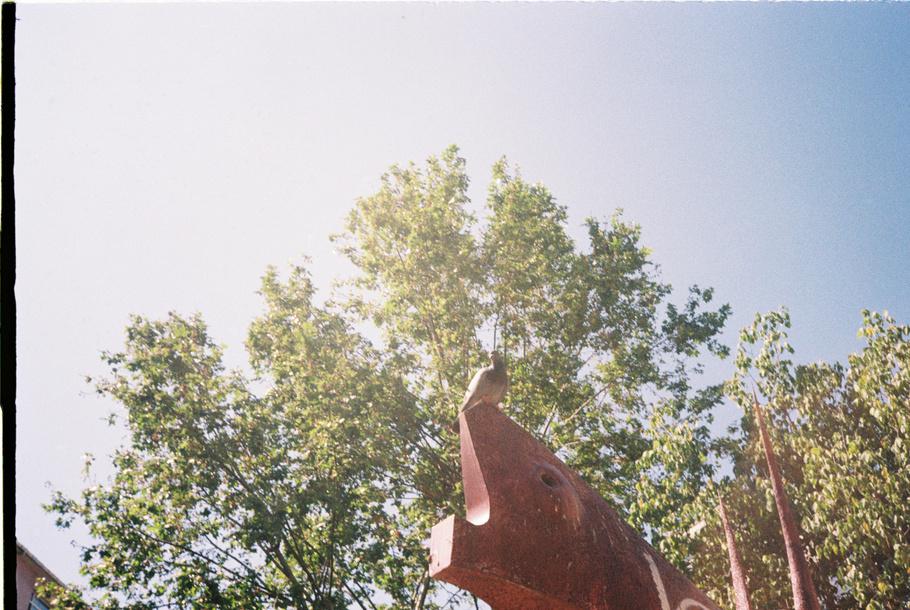
"Photography does not summon the past. The effect it has on me is not to bring back what has disappeared, but to confirm that what I see really did exist." - Roland Barthes, Camera Lucida
Taking a photograph is an act that begins with the sound of the shutter and allows us to reconstruct the world within the rectangular frame of the viewfinder. A photograph is a powerful object of memory that does not end at the moment it is taken but brings that moment back to life each time we look at it. My interest in photography comes not only from my desire to capture the world through my own eyes but also from the relationship I have had with photographs since childhood. I grew up looking through family albums and discovering the memories hidden in old photographs. These images showed me not only photographs taken in the past but also the traces that people, emotions and stories leave in the passage of time. For this reason, photography is not merely a tool for producing images for me; it is a way of bringing the past into the present and making the precious moments hidden within life visible.
Roland Barthes's Camera Lucida, an important work on photography, examines our relationship with photographs from a philosophical perspective. Barthes wrote this book after his mother's death, while reflecting on the relationship between presence, absence and memory through the "Winter Garden Photograph" of her childhood. This personal process transforms the work from a text about photography alone into an inquiry into time, memory and absence. According to Barthes, the fundamental nature of photography can be explained through the French expression "Ça a été." This expression means "this existed, this was here." A photograph shows that whatever appears in the image truly existed at some point and stood before the camera. In this sense, photography acts as a witness, carrying the trace of a past reality into the present.
The Two Sides of Photography: Studium and Punctum
The concepts of "Studium" and "Punctum," which Roland Barthes discusses in Camera Lucida, are two fundamental approaches that explain how viewers experience photographs. Studium refers to the general cultural and social interest we take in a photograph. At this level, viewers interpret the photograph, examine its historical context and understand the collective meanings presented by the image. Evaluating a photograph through the clothing of its period, the social setting in which it was taken and its historical circumstances is a form of reading at the level of Studium. Studium therefore represents the aspect of photography that can be understood culturally and intellectually.
Punctum, on the other hand, is the unexpected effect that a detail of an object within a photograph can have on the viewer. According to Barthes, this detail seems to pierce the viewer. The concept derives from a Latin word associated with a wound, a prick, a small hole or a mark. A glance, a gesture, an object or a seemingly ordinary detail can create a personal impact on the viewer beyond the photograph's general meaning. While examining a family photograph in the book, Barthes draws attention to the necklace around a woman's neck, a small detail that reminds him of his aunt and triggers a connection in his memory. For this reason, Punctum represents a subjective field of experience that goes beyond the culturally readable meanings of a photograph.
For me, taking photographs is not simply a hobby that consists of pressing the shutter button. It is a way of looking at life with curiosity, excitement and love. Barthes's ideas remind me of this: by taking photographs, we do not merely produce images; we also come to understand the transience of time and the value of moments that have passed. Whenever I look through albums, I remember the moments I have experienced and the people who have left their mark on my life, keeping my memories alive. Sometimes, I also search for meaning in a small detail. That is why I will continue to pursue not only aesthetically perfect photographs but also those small and moving Punctums that give meaning to life.
İrem İlayda Arslanoğlu
Yücel Cultural Foundation
Volunteer Writer