Volunteering, Civil Society, and Sustainability
From Global to Local: Civil Society
Although global problems may seem highly complex at the macro level, they always become real on a street and in an individual’s daily life. Civil society and volunteering create a bridge precisely at this point. Every step taken locally forms the most tangible and sustainable part of global change.
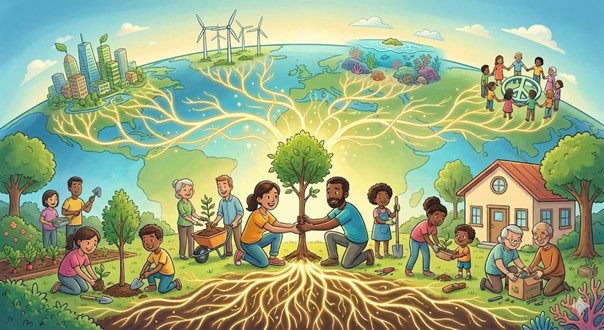
The Power of the Local and the Roots of the Global
Many issues we describe as global are, in fact, the accumulation of local problems that have been ignored. Within the Sustainable Development Goals, “Zero Hunger” begins with a farmer’s soil losing its fertility, while “Climate Action” starts with uncontrolled urbanization in a neighborhood. Global crises do not emerge out of nowhere. They arise from the growth of small problems neglected in our streets and communities. Civil society and volunteering appear precisely at this point. They address local problems together with volunteers. If we fail to solve the waste problem in our streets, that waste will continue until it forms garbage islands in our seas. We should not see volunteering merely as a small act of kindness. It can be described as a bridge that prevents the spread of a global crisis.

Not Saving the World, but Saving the Future
When sustainability is mentioned, environmental damage or protection often comes to mind first. However, sustainability is not limited to this. From a civil society perspective, it goes far beyond saving the world. Sustainability is, in fact, about saving the future. The United Nations goals such as “Responsible Consumption and Production” and “Reduced Inequalities” focus on what we leave behind to future generations. Volunteering is the cleanest and most sustainable force in achieving these goals. What holds a society together is volunteer motivation. An association established to solve a local social issue does not only address today’s problem; it also strives to prevent that problem from recurring in the future. The aim is not merely to help, but to empower. A volunteer movement becomes sustainable when it transforms into a self-sufficient structure within a neighborhood, capable of renewing and adapting itself under different influences.

Invisible Bonds
What keeps a society standing is not only concrete buildings and laws, but the invisible bonds of trust that connect people. In academia, we call this “social capital.” In the culture of civil society, we might call it a “bond of the heart.” Sustainability is not only about protecting nature, but also about safeguarding social trust and peace. If a society has not developed a culture of collective action around shared goals, it becomes extremely difficult—even impossible—to withstand global crises. Civil society is the collective conscience of society. This conscience takes root locally and gains meaning globally. Solidarity built within a neighborhood is an indispensable part of a brighter future.
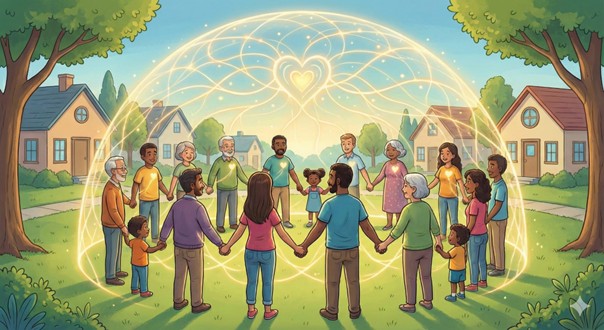
In conclusion, civil society and volunteering are not merely social activities to fill spare time; they are essential structures of global sustainability. Every sincere effort created locally helps prevent the spread of global crises.
Aslı Şahin
Yücel Cultural Foundation
Volunteer Writer