Volunteer Awareness for Sustainable Societies
Volunteering is often seen as an activity through which individuals spend their free time. However, the complex social challenges of our time reveal the inadequacy of this perspective. Poverty, climate crisis, access to quality education, and structural problems in the field of arts and culture cannot be solved solely through short-term policies or temporary interventions. Therefore, volunteering must move beyond being a leisure activity and become a natural part of everyday life.
The concept of sustainable volunteering requires acknowledging that volunteering demands continuity, planning, and responsibility. In this process, the volunteer is not merely a participant visible in public activities but also an actor who works behind the scenes, assumes responsibility, and takes initiative when necessary. Just as salt, an essential element of a meal, ensures its integrity, the volunteer’s determination to continue contributing represents the sustainability of this field.
Volunteers are individuals who raise awareness, engage in advocacy, generate solutions during crises, and create social benefit. In this respect, volunteering is not only a tool that transforms society but also an important experiential space that supports personal development. The sense of responsibility, communication skills, and social sensitivity gained by volunteers produce positive outcomes at both individual and collective levels.
Volunteering enables individuals to establish an ethical sense of responsibility by considering the needs of the communities in which they live. Acting with sensitivity toward social needs strengthens inter-institutional communication and cooperation. This expands the volunteer’s sphere of influence and contributes to the development of a sustainable volunteering ecosystem. Such collaborations allow volunteering to move beyond being a temporary experience and evolve into long-term social contribution.
At the individual level, sustainable volunteering is a concrete expression of active citizenship. The volunteer becomes someone who does not remain indifferent to societal issues and does not avoid responsibility. In this process, keeping the question “What can I do for the society I live in?” alive in one’s mind is crucial. The spread of volunteering, especially among young people aged 16–30, contributes to building a more participatory, sensitive, and solidarity-based society. Engaging in volunteer work aligned with individuals’ interests and competencies ensures greater effectiveness and sustainability.
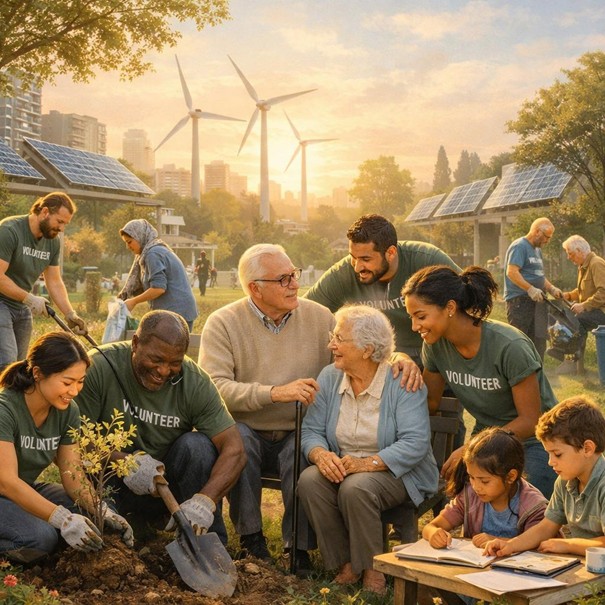
In conclusion, sustainable volunteering may begin as a personal choice; however, as volunteers become more involved in the process, they begin to derive meaning and fulfillment from their work. This experience allows volunteers to see themselves as part of a broader social ecosystem. Considering that there is no other world than the one we live in, making sustainable volunteering an integral part of life becomes inevitable. Remaining indifferent to social issues contradicts our responsibility toward a shared future.
Tugay Şen
Yücel Cultural Foundation
Volunteer Writer