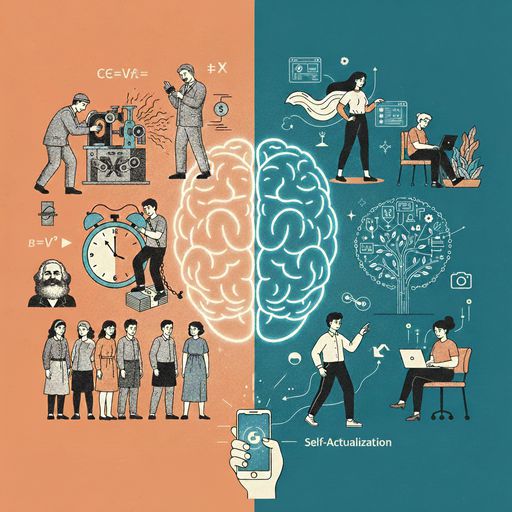
Today, young people are moving away from traditional work models and turning toward innovative models integrated with the digital world. This shift is the result of a growing awareness of the imbalance between labour and value. Karl Marx’s concepts of the worker, labour power, and surplus value provide an important theoretical framework for understanding this situation. According to Marx, labour power is treated merely as a tool within the production process, and the real value created by the worker is often rendered invisible. Surplus value refers to the difference between the total value produced by the worker and the amount returned to them as wages. For Marx, this means that the worker does not receive the full value of their labour and is subjected to systematic exploitation.
Rather than adapting to a system in which they cannot fully receive the value of their labour, young people question the meaning of work by engaging with Marx’s concepts. Beyond material value, dimensions such as creativity, flexibility, job satisfaction, self-expression, and contributing to society are also important to them. The value of work is no longer measured solely by financial gain but by these multidimensional contributions. Historically, changing approaches to work across generations support this shift. While the Baby Boomer generation embraced a “live to work” mindset, Generation X transformed this into “work to live.” Generation Y viewed work as a means to earn income while gaining experience and developing in different fields. Generation Z, raised in the digital world, expects work and life to offer not only financial rewards but also opportunities for personal and social value creation.
This transformation can also be understood from a psychological perspective. Maslow’s Hierarchy of Needs plays a key role in understanding individual motivations and priorities. According to Maslow, needs progress from physiological and safety needs to love, esteem, and self-actualization. Especially at higher levels of this hierarchy, it becomes clear that young people place greater importance on personal development, experience, exploration, and socio-cultural interaction in balancing work and life.
Digital platforms also empower young people within the world of work by enabling them to share experiences and challenges. In this way, individual awareness merges with collective consciousness. However, while this awareness grows, the difficulties created by existing work structures persist. Current models that expect multiple responsibilities under a single title often prevent individuals from fully realizing their potential and lead to loss of motivation. In this context, human resources approaches in corporate communication gain importance. This approach recognizes people as the most valuable resource of an organization and prioritizes employee development, satisfaction, and participation. Open communication, trust, teamwork, and feedback are among its core elements.
In conclusion, Marx’s concepts are no longer confined to theoretical knowledge taught in classrooms but are increasingly understood and practiced in everyday life. Young people who are also aware of Maslow’s Hierarchy of Needs place growing importance on self-actualization. This awareness contributes to increased self-respect and empowerment in professional life. By turning toward creative, fair, and sustainable work models, young people are taking steps toward building a world shaped by their own potential.
İrem İlayda Arslanoğlu
Yücel Kültür Vakfı
Volunteer Writer