The process of discovering oneself initially begins with recognizing and making sense of one’s immediate surroundings. Sounds and images that first appear blurred gradually become clearer. Over time, we start to understand who those sounds and images belong to. Then, each of us begins our educational journey at school, and our perceptions of the world slowly start to change. Beyond our core family, we learn to build our own social circles and begin to be defined by different responsibilities and roles in life. This process, continuing from kindergarten through primary school, forms a familiar and average academic journey for most of us. First through our families and later through our experiences at school, we begin to get to know ourselves. What truly makes me reflect here is this question: when do we realize our inner potential, or truly understand what we actually love?
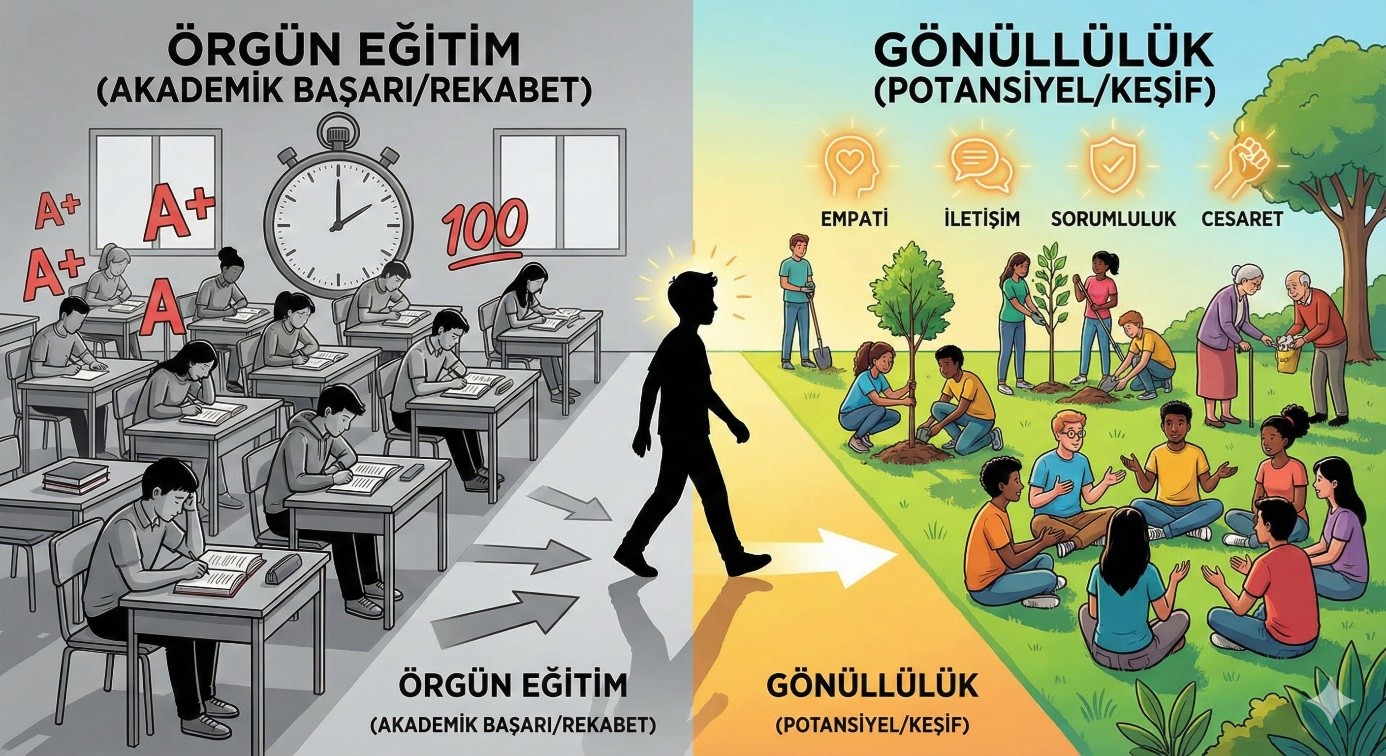
Rather than debating the education model itself, most of us graduate after going through a standardized and similar curriculum during a certain period of our lives. University years may offer some differences, yet students generally take similar courses in pursuit of an overall unity. A person’s success and visibility are defined by grades. But does the foundation young people need to fully realize their potential truly begin at school desks? I might partially say “yes,” but it does not feel sufficient.
At this point, volunteering activities within civil society organizations, associations, and school communities offer, in my view, spaces for both growth and discovery. In short, volunteering functions as a supportive mechanism that helps young people uncover their potential. Through volunteering, the responsibilities they take on, the solutions they produce when facing problems, the communication skills they develop in moments of conflict, and the courage to take initiative all contribute to the growth of their potential.
I believe that, compared to formal education, young people feel braver and more secure in these environments. What leads me to this thought is the pressure created by family and social expectations in school life, where grades and exams constantly trigger performance anxiety. Instead of engaging in activities that nurture emotional intelligence or help them discover what they love and what they are good at, young people are expected to succeed in exams, such as mathematics, to achieve the highest possible score. Only then can they be seen as promising young individuals who meet expectations.
Volunteering, however, is a journey where people move together with a collective awareness, aiming to create shared benefit and value rather than compete. In this space, individuals also support their own strength and potential through conscious awareness. They nurture an inner sense of “feeling good about oneself,” while helping soften sharp edges and strengthen understanding, tolerance, and empathy.
Within these experiences, individuals recognize their own potential and knowledge, make efforts to overcome weaknesses, and develop their strengths. By meeting people from different fields, they are drawn into a space of connection that broadens their horizons.
In conclusion, while formal education often focuses on academic achievement, volunteering provides a space where young people discover themselves and encounter opportunities for growth. Community-based work shows us that it serves as a more fundamental and effective support mechanism than school life in developing personal potential in a holistic and practical way.
Sıla Korkut
Yücel Kültür Vakfı
Volunteer Writer